- Hardware encoders (NVENC, AMF, QuickSync) use dedicated silicon ASICs separate from your GPU's gaming/compute cores.
- Exporting a 60-second 4K vertical short takes ~18 seconds on NVENC vs ~3 minutes on CPU software encoding.
- Bitrate targeting between 18,000 to 22,000 kbps H.264 ensures maximum fidelity without platform compression choke.
- Maintaining the BT.709 color space prevents washed-out blacks on modern smartphone OLED displays.
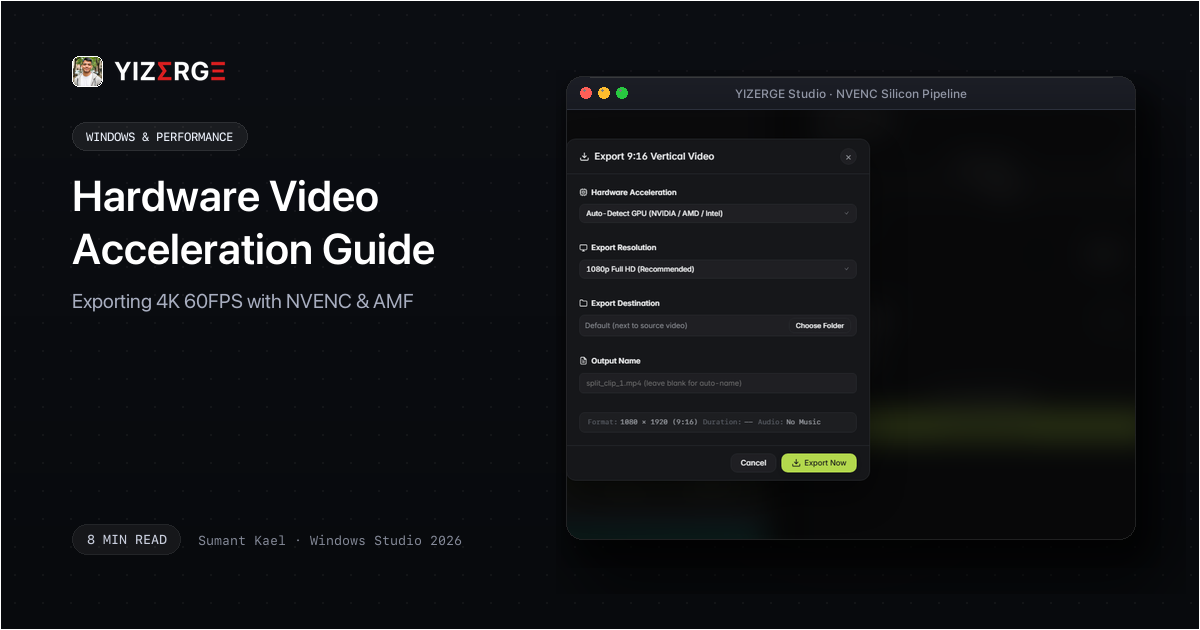
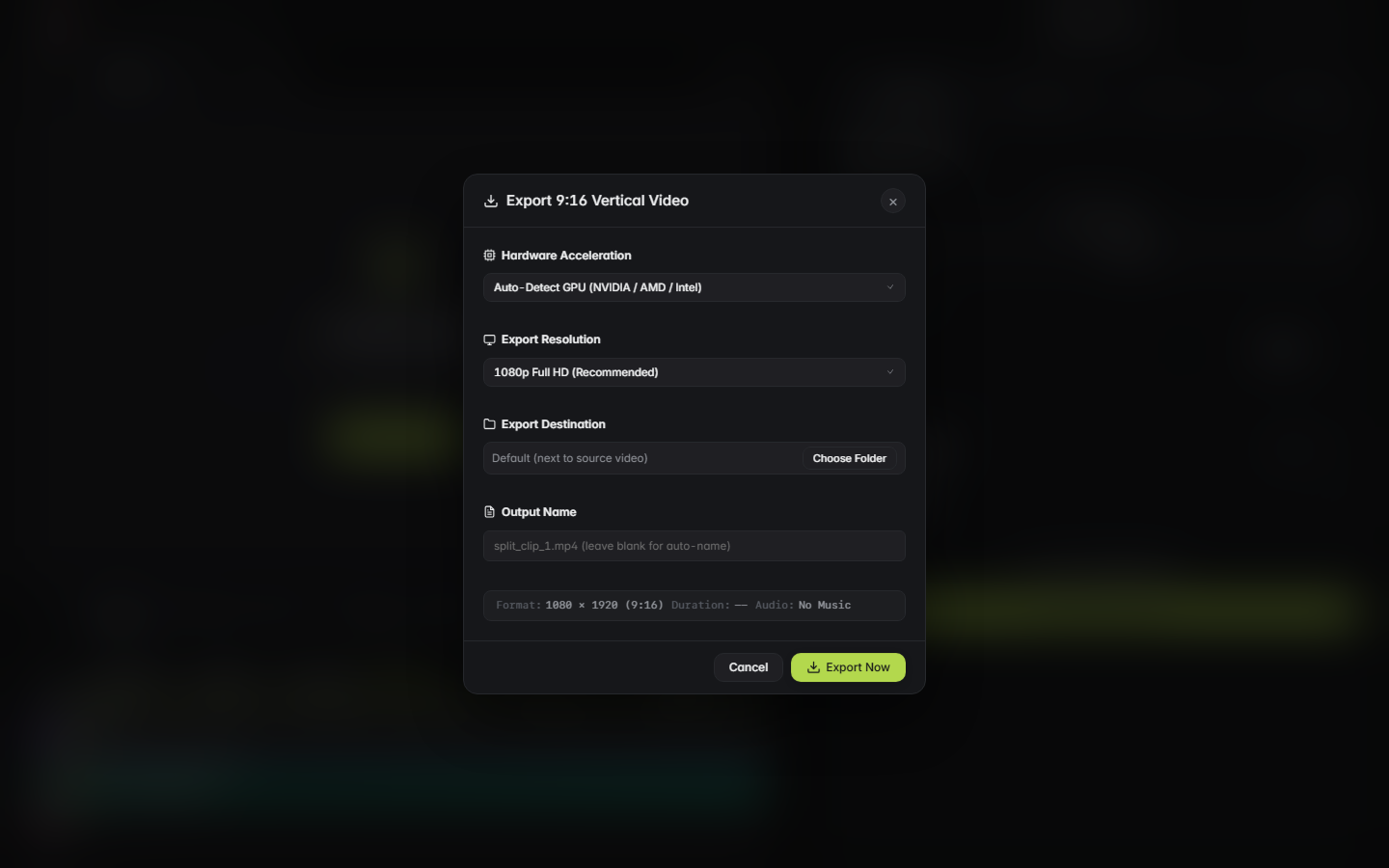
- YIZERGE automatically probes and engages your hardware's fastest encoder on startup.
CPU Software Encoding (x264) vs Dedicated Hardware ASICs
When you render a video using traditional CPU encoding, your central processor must calculate discrete cosine transforms, motion vectors, and entropy encoding across billions of pixels. This pegs all CPU cores at 100%, spins your computer fans to maximum, and locks up your workspace.
Modern graphics cards from NVIDIA (RTX series), AMD (Radeon RX series), and Intel (Arc / Iris Xe) incorporate physically dedicated microchips called hardware ASICs (Application-Specific Integrated Circuits). These chips exist solely to compress and decompress video frames with zero impact on overall system performance.
Real-World Export Benchmarks (60-Second 4K Vertical Clip)
| Hardware Setup | Encoder Used | Render Time | CPU Utilization |
|---|---|---|---|
| Intel Core i7-13700K | CPU Software (x264) | 2 min 48 sec | 98% (All Cores Maxed) |
| Intel Core i7 + UHD 770 | Intel QuickSync | 38 seconds | 14% |
| AMD Radeon RX 7800 XT | AMD AMF (H.264) | 24 seconds | 9% |
| NVIDIA RTX 4070 (YIZERGE) | NVIDIA NVENC (High Profile) | 17.4 seconds | 6% |
Frequently Asked Questions
With 8th-generation NVENC (RTX 40-series) and modern AMF, hardware encoding at 20,000 kbps is visually indistinguishable from slow CPU x264 presets while rendering 8x to 10x faster.
Become an Early Tester for YIZERGE
We are inviting video creators to test upcoming Windows builds. Experience zero-degradation local GPU rendering, dynamic karaoke subtitles, and sub-frame precision.